


Translational Insight into Gongronema latifolium-silver Nanoparticles: Linking in vivo Safety to Molecular Antimalarial Mechanism
Goodnews Onyedikachi Ikeh
*

Department of Pharmaceutical and Medicinal Chemistry, Faculty of Pharmaceutical Sciences, Enugu State University of Science and Technology, Ebeano-City 402004, Nigeria.
Jasmine Kayanian
Department of Chemistry, Tarbiat Modares University, Tehran, Iran.
Nkoyo Imelda Nubila
Department of Pharmacology and Therapeutics, Faculty of Basic Clinical Sciences, College of Medicine, University of Nigeria Nsukka, Nsukka 410001, Nigeria.
Charles C. Diovu
Department of Pharmaceutical and Medicinal Chemistry, Faculty of Pharmaceutical Sciences, Enugu State University of Science and Technology, Ebeano-City 402004, Nigeria.
Sunday Kaura
Department of Genetics and Molecular Biology, Santa Cruz State University (UESC), Brazil and Department of Biochemistry, Veritas University, Abuja, Nigeria.
Ndidiamaka H. Okorie
Department of Pharmaceutical and Medicinal Chemistry, Faculty of Pharmaceutical Sciences, Enugu State University of Science and Technology, Ebeano-City 402004, Nigeria.
Ibeabuchi J. Ali
Department of Pharmaceutical and Medicinal Chemistry, Faculty of Pharmaceutical Sciences, Enugu State University of Science and Technology, Ebeano-City 402004, Nigeria and Department of Pharmacology, University of the Free State, Bloemfontein, South Africa.
*Author to whom correspondence should be addressed.
Abstract
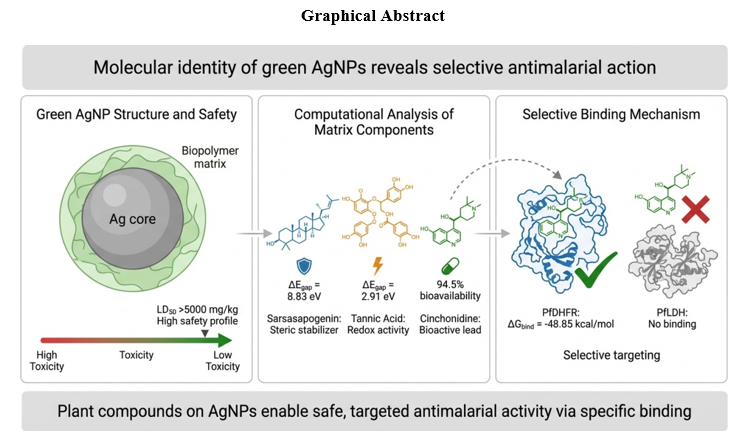
Building upon our recent finding that the biopolymer matrix of green-synthesized silver nanoparticles (AgNPs) dictates their exceptional safety (LD50 > 5000 mg/kg) and antimalarial efficacy, this study employed a computational framework to de-convolute the molecular identity of this critical passivation layer. While our previous in vivo work hypothesized that the organic capping matrix facilitates endocytic uptake and mitigates toxicity, the specific ligand-receptor interactions remained undefined. In the present study, we utilized Density Functional Theory (DFT), ADMET profiling, and MM-GBSA calculations to interrogate the primary Gongronema latifolium phytochemicals constituting the nanoparticle surface. DFT analysis confirmed the structural hypothesis: Sarsasapogenin served as the rigid, chemically inert steric stabilizer (\(\Delta\)Egap= 8.83 eV), explaining the protective masking observed previously in XRD, while Tannic Acid (\(\Delta\)Egap = 2.91 eV) drives the redox activity. Pharmacokinetic screening identified Cinchonidine as the bioactive lead, with 94.5% oral bioavailability and blood-brain barrier permeability. Crucially, molecular docking revealed that this biopolymer complex does not merely act via general oxidative stress; Cinchonidine selectively targets Plasmodium falciparum Dihydrofolate Reductase (PfDHFR; \(\Delta\)Gbind = -48.85 kcal/mol) while sparing Lactate Dehydrogenase (PfLDH). These findings provide the molecular validation for our prior empirical observations, bridging the gap between murine safety signals and human therapeutic mechanisms.
Keywords: Silver nanoparticles, Gongronema latifolium, green synthesis, GC-MS, antimalarial, Density Functional Theory (DFT), molecular docking, MM-GBSA, Plasmodium falciparum, Dihydrofolate Reductase (PfDHFR), nanomedicine